



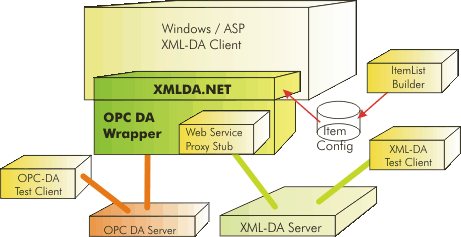
The XmlDA.Net Wrapper Component simplifies the development of XML-DA client applications and supports access to OPC-DA V2 servers.
Clients are developed according the XML-DA specifications V1.0.
The XmlDANet.dll is referenced in place of a XML-DA web reference and allows the client to access either XML-DA or OPC-DA V2 servers, just by specifying a different server URL.
The OPC-DA servers are accessed without any XML serialization, resulting in much better performance than possible with an extenal XML - OPC gateway.
|
The XmlDANet assembly is added to the application and handles:
|
The provided tools help develop and debug the application:
|
 |
Supported Target Platforms:
XMLDA.NET supports multiple application platforms. The application developer has to use the XmlDANet assembly for the platform the application is developed for:
a) Server Communication
- .NET2 web services
The client application uses the XML DA specified SOAP messages to access the XML DA server.
OPC DA servers are accessed through the XMLDANET internal DCOM wrapper
- .NET3 or .NET4 Windows Communication Foundation (WCF)
The XML DA server access is through WCF methods. The communication binding can be selected in the application configuration file.
For access to .NET2 XML DA server the basicHttpBinding has to be used.
For access to WCF based XML DA servers any of the WCF bindings can be used to make the communication either high performance or secure.
b) User Interface
- Windows Forms
Some classes, such as BrowseTree, BrowseTreeList and DataBind, transfer data into Windows controls and may have to be thread synchronized.
The methods in XmlDaNet.dll and XmlDaNetWCF.dll do this for Windows Forms applications.
- .NET3 Windows Presentation Foundation (WPF)
The classes BrowseTree, BrowseTreeList and DataBind transfer data directly into WPF controls and are thread synchronized as necessary.
The methods in XmlDaNetWPF.dll and XmlDaNetWCFWPF.dll work in WPF desktop and WPF web applications.
- Windows Service
The server access methods are independent of the application type. They can be used in any type of application and don't require a user interface.
Use the XmlDANet.dll or XmlDaNetWCF.dll for Windows Service or Console applications.